Outdoor Adventures in Namibia
Namibia’s Stunning Nature and Culture
Namibia’s Stunning Nature and Culture
Namibia is a paradise for outdoor enthusiasts, offering a blend of breathtaking wildlife, endless desert landscapes, and rich indigenous cultures. Whether you're seeking thrilling safaris, exciting kayaking excursions, or awe-inspiring stargazing, Namibia delivers unforgettable experiences for nature lovers and adventurers alike.
In this article, we present seven extraordinary outdoor activities that will make your trip to Namibia truly exceptional.

Safari in Etosha National Park
This is what to expect
A Safari in Etosha National Park is one of the most impressive natural experiences in Namibia. The park covers around 22,000 square kilometers and is known for its breathtaking landscapes as well as its extraordinary wildlife.
The centerpiece of the park is the Etosha Pan, a massive salt pan of about 4,760 square kilometers, so distinctive that it can even be seen from space. The surrounding landscape consists of dry grass savannahs, bushland, and mopane forests, providing ideal habitats for numerous wildlife.
More than 30 waterholes serve as vital drinking stations for the wildlife – especially during the dry season from May to October. These seasonal waterholes are ideal spots for spectacular wildlife observations. Some camps in the park even offer illuminated waterholes, making night safaris a very special experience.
Experience and Highlights
The Etosha National Park is known for its outstanding opportunities to observe the Big Five – with the exception of the buffalo. Visitors have the chance to see elephants, lions, leopards, and rhinoceroses up close. Particularly impressive are the black rhinoceroses, which can be spotted in the western part of the park.
In total, over 114 species of mammals live in the park, including giraffes, zebras, cheetahs, hyenas, and various species of antelopes. The seasonal change of the Etosha Pan is notably fascinating:
- During the dry season, it appears as an endless white dust plain.
- After the rainy season, it transforms into a shallow lake, attracting thousands of flamingos and waterbirds.
Another highlight is the mating season during the dry season, where animals like the blue wildebeest, the black-faced impala, and the springbok engage in spectacular fights for dominance.
The combination of diverse wildlife, unique landscapes, and seasonal natural phenomena makes a safari in Etosha National Park an unforgettable experience.
Practical Information
Best Travel Time
The best time for a safari is the dry season from May to October. During this time, animals gather at the waterholes, significantly increasing the chances of spectacular observations. The months of July to September are considered particularly recommended.
Safari Options
There are two ways to explore the park:
- Self-drive safari:
- Offers maximum flexibility in route and daily planning.
- Viable even without a four-wheel drive due to well-developed gravel roads.
- A park map (around 10 Euros) helps with navigation.
- Guided safari:
- Benefits from the trained eyes of experienced guides.
- Provides comprehensive information about the wildlife and the ecosystem.
- Ideal for anyone who wants to focus on observation.
Important Equipment
- Clothing:
- Long sleeves & pants (protection from sun & insects)
- Warm clothing for morning safaris
- Hat & sunglasses
- Closed shoes
- Practical items to bring:
- Sufficient water, fuel & snacks
- Binoculars & camera for the best wildlife shots
- Park map or app for navigation
Additional Tips
- Early booking recommended, especially in high season.
- Plan several days to experience the park's diversity.
- Observe safety rules:
- Do not underestimate distances.
- Only get out at marked places.
- Vehicle gatherings often indicate animal sightings.
A safari in Etosha National Park is a must for travelers to Namibia and offers unique wildlife experiences in a spectacular setting.
Kayak Tour with Seals at Walvis Bay
This is what to expect
A kayak tour with seals at Walvis Bay is one of the most extraordinary natural experiences in Namibia. This activity combines fascinating wildlife with impressive coastal landscapes and offers an eco-friendly way to experience marine mammals up close.
What makes these tours special:
- Cape fur seals are extremely curious and playful – they swim around the kayaks, jump out of the water, and even play with the paddles.
- Since kayaks do not produce motor noise, the animals are less disturbed than during boat tours, allowing for an intense nature experience.
- The tours are usually organized in small groups, creating a personal and undisturbed atmosphere.
The main starting point for the kayak tours is Pelican Point, a peninsula with one of the largest seal colonies in the world – up to 60,000 animals live here year-round. The sheltered location ensures calm waters and makes the area ideal for kayakers.
In addition to the playful seals, there is a diverse birdlife in the lagoon, including flamingos, pelicans, and cormorants. With some luck, paddlers may also encounter Heaviside's or Benguela dolphins – and during whale season (July to November) even humpback whales or southern right whales.
The combination of wildlife observation, quiet movement, and the breathtaking scenery makes a kayak tour in Walvis Bay an unforgettable experience.
Experience and Highlights
During a kayak tour with seals, visitors experience Namibia's wildlife up close:
- The Cape fur seals are extremely sociable, swimming right up to the kayaks and even playing with the paddles.
- Some seals curiously nibble at the boats or perform jumps out of the water.
- Tour participants have a unique opportunity to observe these animals in their natural habitat.
The scenery also makes the kayak tour particularly impressive:
- The tour passes through the lagoon of Walvis Bay, past salt mines and the impressive dune landscape.
- The starting point Pelican Point offers spectacular views of the sand dunes and the Atlantic Ocean.
In addition to the seals, there are many more animal encounters:
- The seal colony at Pelican Point includes up to 50,000 animals.
- Heaviside's and Benguela dolphins are frequently sighted in the area.
- During whale season (July to November), with some luck, humpback whales, southern right whales, or even dwarf right whales can be observed.
- The lagoon is also a paradise for birdwatchers – with flamingos, pelicans, and cormorants.
The quiet gliding in the kayak allows for a completely new perspective on Namibia's marine world, away from motor noise and large tourist flows.
Practical Information
Best Travel Time
The optimal time for a kayak tour with seals in Walvis Bay is between May and September, as the weather is stable and the water is usually calm during these months.
- It can be cool in the mornings, especially in August with temperatures around 10-15°C.
- Most tours start early in the morning when the sea is still smooth.
Clothing and Equipment
- Sun protection: Sunscreen & headgear are essential.
- Waterproof clothing: Providers usually supply water-repellent clothing & life jackets.
- Recommended clothing:
- UV protection shirts with long sleeves
- Swimwear
- Quick-drying clothing for after the tour
- Shoes: Sturdy water shoes or sandals with non-slip soles
- Extras:
- Sunglasses (secured with a glasses strap)
- Waterproof camera or protection for electronic devices
Additional Notes
- No prior kayaking experience required – suitable for beginners.
- Duration of the tours: Typically 4-5 hours.
- Best conditions: Early mornings often have ideal water conditions.
With these tips, nothing stands in the way of a unique experience with the playful seals of Walvis Bay!
Night Safari in Erindi Private Game Reserve
This is what to expect
A night safari in Erindi Private Game Reserve offers a completely new perspective on Namibian wildlife. While many animals rest during the day, they become active at nightfall. Visitors have the chance to observe rare nocturnal animals that are hardly seen during a normal safari.
Typical sightings include bat-eared foxes, jackals, porcupines, pangolins, and aardvarks. Predators like lions, leopards, and hyenas are particularly active at night, providing exciting observation opportunities. With a bit of luck, even honey badgers or caracals can be spotted.
In addition to the fascinating wildlife, the atmosphere creates an unparalleled experience:
- The silence of the night, interrupted by the calls of nocturnal animals.
- A crystal-clear starry sky, free of light pollution.
- Spectacular tension as the animals move silently in the dark.
Night safaris in Erindi often take place on exclusive routes that are not accessible to regular visitors. Spotlight help to locate animals in the dark – care is taken not to blind them.
Experience and Highlights
The Erindi Private Game Reserve offers a unique variety of nocturnal animals that can be particularly well observed during a night safari:
- Rare species: bat-eared foxes, pangolins, aardvarks, and bushbabies.
- Predators in action: Lions, leopards, and hyenas are often easier to see at night.
- Owls and owlets that glide silently through the darkness.
- With luck: Honey badgers or caracals – two of the most difficult animals to spot.
Additionally, the nighttime scenery provides unforgettable impressions:
- The roaring of lions at night – an experience that gives you goosebumps.
- The sparkling starry sky, which appears particularly intense without light pollution.
- Excitement and thrill, as many animals move silently in the dark.
A special highlight is the opportunity to drive on exclusive paths with experienced guides, which are not accessible to regular visitors. This makes the night safari a particularly intense and exclusive experience.
Practical Information
Best Travel Time
The best time for a night safari in the Erindi Private Game Reserve is the dry season from July to October. During these months:
- Animals gather at the few water points – perfect conditions for wildlife observation.
- The vegetation is sparser, which improves the visibility of the animals.
- Temperatures are pleasantly warm during the day but cool in the evening.
Equipment & Clothing
For a night safari, proper preparation is crucial:
- Warm clothing: Fleece jacket, long pants & closed shoes for the cool evenings.
- Headgear: Wool hat for cold nights.
- Binoculars: At least 8x38 magnification for better observation of animals.
- Camera: Interchangeable lenses for high-quality night shots.
- Flashlight with red light: To avoid blinding animals.
- Insect repellent: Particularly important against nocturnal insects.
- Light blanket: For extra warmth on open safari vehicles.
Rules of conduct for the night safari
- Stay in the vehicle unless the guide explicitly allows otherwise.
- Speak quietly to avoid disturbing the animals.
- Do not use flash photography, as it may scare the animals.
- Follow the guide's instructions to ensure a safe safari.
- Do not use strongly scented perfumes or creams, as these could attract animals.
- Maintain a safe distance – do not approach or disturb the animals.
Thanks to this preparation, the night safari in the Erindi Private Game Reserve becomes an intense and unforgettable experience in the Namibian wilderness.
Hiking in the Erongo Mountains
What to Expect
The Erongo Mountains are one of the most spectacular hiking areas in Namibia, renowned for their unique geology and breathtaking rock landscapes.
The region is an eroded volcanic cone with 11 distinct crater basins, rising about 1000 meters from the surrounding plains. Characteristic are the huge granite boulders, bizarrely shaped rock formations, and impressive gorges. The highest point of the mountain range is Hohenstein at 2,319 meters.
In addition to the extraordinary landscape, the Erongo Mountains offer impressive biodiversity. It is a 'hotspot of endemism' and is home to rare animal species such as the Hartmann's zebra, Damara dik-dik, and black-faced impala. Furthermore, there are over 190 bird species and numerous endemic reptiles and plant species.
Thanks to the diverse hiking routes, the possibility of wildlife observation, and the fascinating prehistoric rock paintings, the Erongo Mountains are a paradise for nature and culture lovers.
Experience and Highlights
A hike in the Erongo Mountains leads through a fascinating granite landscape of volcanic origin with spectacular viewpoints:
- Bull’s Party – a collection of huge granite boulders shaped by erosion, perfect for photography.
- Elephant in Rock – a striking rock that resembles an elephant's head.
- Surreal rock gorges and granite forests that make the landscape unique.
A special highlight is the prehistoric rock paintings that attest to the early settlement of the region. Particularly impressive:
- Phillip's Cave – one of the most significant sites with paintings of a white elephant, giraffes, rhinoceroses, and human handprints. The cave is 15 meters deep, 35 meters long, and 7 meters high and is a protected site.
- San rock paintings on the Etamba farm, providing a unique insight into the history of the region.
- San cultural village, which offers visitors the opportunity to learn more about the culture and way of life of the San.
In addition to cultural highlights, the Erongo Mountains offer diverse hiking routes for different difficulty levels:
- The 'Absolute Erongo Hike' – a 1.5-day guided tour through untouched wilderness.
- Multi-day trekking tours where hikers can stay in wilderness camps.
- Morning and evening hikes where the rocks shine in magical light.
Thanks to this combination of impressive geology, diverse wildlife, and fascinating cultural history, the Erongo Mountains are among the best hiking destinations in Namibia.
Practical Information
Hiking Options by Difficulty Level
- For Beginners:
- Short hikes to Phillip's Cave (about 40 minutes).
- Easy walks through the granite landscape, ideal for families.
- Guided hikes on the Ameib Farm, suitable for inexperienced hikers.
- For Advanced Hikers:
- The 'Absolute Erongo Hike' – 1.5 days through the heart of the mountain with an overnight stay.
- Mount Erongo Trail, which leads to the highest point of the mountains.
- Multi-day hiking tours with overnight stays in wilderness camps.
Best Travel Time
The best time for hiking is the dry season from May to October, as pleasant conditions prevail:
- Pleasant temperatures of 20–25°C during the day.
- Little precipitation, which means dry and well-maintained paths.
- Optimal wildlife observation, as animals are easier to see at waterholes.
- July and August are particularly recommended, when the climate is mild.
Important Equipment
- Sturdy footwear – robust hiking shoes are essential.
- Sun protection – hat, sunglasses, and sunscreen are indispensable due to the strong sun exposure.
- Sufficient water – the dry environment requires good hydration.
- Warm clothing for the night – temperatures can drop to 0°C or below.
- Camera & binoculars – for spectacular landscape shots and wildlife observations.
- First aid kit – for minor injuries or emergencies.
- All-terrain vehicle – for access to remote hiking areas.
Additional Tips
- Early booking is recommended, especially during peak season (July–August).
- Hikes early in the morning or late in the afternoon offer the best light conditions for photographers.
- Observe safety precautions:
- Some hiking routes are only accessible with a local guide.
- Check current weather conditions at the site.
- Ensure adequate water supplies.
The Erongo Mountains combine breathtaking landscapes, rich wildlife, and cultural highlights – an unforgettable hiking destination for travelers to Namibia.
Stargazing in the Namib
What to Expect
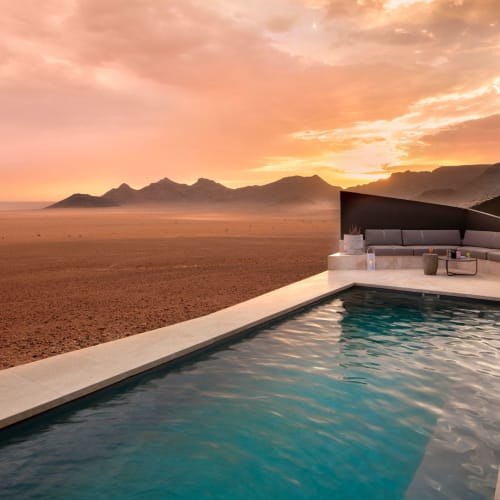
The Namib Desert is one of the best places in the world for stargazing. Thanks to minimal light pollution, dry air, and untouched nature, it offers an extraordinary view of the night sky.
A special highlight is the NamibRand Nature Reserve, which has been awarded Gold status as an International Dark Sky Reserve – one of the highest honors for starry regions. Other excellent observation spots include:
- Sossusvlei – known for its crystal clear night sky.
- Gamsberg – one of the three best observation sites in the southern hemisphere.
- Guest farm Hakos & Rooisand Desert Ranch – offer guided astro-tours with professional telescopes.
- Kiripotib Astrofarm – specialized for amateur astronomers with extensive equipment.
Due to its geographical location in the southern hemisphere, the center of the Milky Way is especially well visible – a sight that cannot be experienced in Europe or North America.

Experience and Highlights
Stargazing in the Namib is a magical experience. Here, the Milky Way is so bright that it casts shadows – a rare phenomenon that can only be seen in the darkest places on Earth.
Further special highlights:
- The Southern Cross, one of the most distinctive constellations in the southern hemisphere.
- Large & Small Magellanic Cloud, two fascinating companion galaxies of our Milky Way.
- Over 6000 visible stars – far more than in the Northern Hemisphere.
- The Coal Sack, a dark interstellar cloud that is only visible in absolutely dark regions.
In addition to pure star observation, the landscape also contributes to the fascination:
- The vast, open desert landscape allows an unobstructed view to the horizon.
- The extreme dryness of the air provides exceptional clarity and visibility.
- Places like the NamibRand Nature Reserve offer nearly complete darkness and enhance the contrast to the starry sky.
Many visitors describe the experience as the feeling of "standing in the middle of the Milky Way" – an unparalleled natural phenomenon that makes Namibia one of the best places in the world for astronomy enthusiasts.
Practical Information
Best Time to Travel
The best months for stargazing are from May to November. During this dry season, the nights are mostly cloudless and the atmosphere particularly clear.
Especially beneficial are:
- May – warm nights & clear visibility after the rainy season.
- September – high number of clear nights with optimal conditions.
Equipment for Stargazing
For an optimal experience, the following aids are recommended:
- Binoculars – ideal for beginners.
- Tripod – stabilizes the image for longer observations.
- Camera with manual settings – for astrophotography.
- Light-sensitive wide-angle lens & remote trigger – for long exposures.
Many lodges and guest farms also provide telescopes with diameters of up to 16 inches.
Visit to the Waterberg Plateau
What to Expect
The Waterberg Plateau is one of the most distinctive geological phenomena in Namibia. This impressive tabletop mountain rises about 200 meters above the surrounding landscape and extends over 48 kilometers in length and 15 kilometers in width. Its area of over 400 square kilometers consists of reddish sandstone that was deposited about 150-190 million years ago during the Karoo period.
A unique geological feature makes the Waterberg Plateau stand out: the porous sandstone stores rainwater like a sponge, while an impermeable clay layer prevents it from seeping away. This creates permanent springs and a relatively lush vegetation that sharply contrasts with the surrounding dry savanna landscape.
The plateau is not only scenically fascinating, but also a hotspot for biodiversity:
- 500 plant species, including wild fig trees, fire lilies, and coral trees. Some of them are endemic.
- 90 species of mammals, including elephants, giraffes, lions, leopards, cheetahs, kudus, oryx antelopes, zebras, and buffalo.
- Over 200 species of birds, including the rare Cape vulture, which has one of its few breeding grounds here.
- Reptiles and amphibians, with 45 species of snakes, 34 species of lizards, and 13 species of frogs.
As a protected area for endangered species, the plateau plays an important role in reintroduction projects. Particularly significant is the protection of black and white rhinoceroses, which have been successfully established here.
Experience and Highlights
A visit to the Waterberg Plateau offers a wide array of hikes, wildlife observations, and historical experiences.
Hikes & Nature Experiences
- Plateau Hike: A 2-3 hour guided tour with a spectacular view of the Kalahari Plain.
- Mountain View Trail: Ideal for guests of the Waterberg Camps with impressive scenery.
- Nature Walks: Marked paths (1-5.3 km) through the valley of the nature reserve with viewpoints and information boards.
- Honeymoon Sundowner: An exclusive evening tour with a romantic sunset on the plateau.
History & Culture
- History Path: A 2.2 km long hiking trail that passes memorials of the Battle of Waterberg (1904) and a former refugee camp.
- Prehistoric Traces: 200 million-year-old dinosaur footprints and thousands-of-years-old rock paintings of the San have been discovered at Waterberg.
- Soldiers' Cemetery: A memorial for the fallen German soldiers of the colonial era.
- San Culture: Until the 1960s, a small San tribe lived on the plateau and maintained their traditional ways of life.
Wildlife Observations & Safaris
- Rhino Drive: A 2-3 hour safari through the bush savanna at the foot of the Waterberg with a high chance of spotting rhinos.
- Rhino Tracking: A 3-4 hour guided morning tour with professional trackers who spot wildlife.
- Birdwatching: Especially recommended for bird lovers – with over 200 species, including the Cape vulture.
This versatile combination of nature, history, and wildlife makes the Waterberg Plateau a special travel destination.
Practical Information
Best Time to Travel
- Dry Season (May to October):
- Pleasant temperatures between 20°C and 25°C.
- Animals gather at water sources, ideal conditions for wildlife observation.
- Hiking trails are easily accessible.
- Rainy Season (November to April):
- Landscape is lush green, but paths can be slippery.
Activities & Tours
- Plateau Hike: 2-3 hours, guided, breathtaking views.
- Mountain View Trail: Perfect for guests of the Waterberg Camps.
- Nature Walks: Various lengths with information boards about flora and fauna.
- Rhino Drive: Safari in the bush savanna, 2-3 hours.
- Rhino Tracking: 3-4 hours with professional guides.
- History Path: Historical 2.2 km long hiking trail.
Note: All accommodations offer solar power and limited Wi-Fi. Early booking is recommended, especially in high season (May to October).
Cultural Encounters with the Himba or San
What to Expect
Cultural encounters with the Himba or San in Namibia offer unique insights into two of the oldest indigenous peoples of Africa. These groups have preserved traditional ways of life over the centuries, which are now threatened by modern influences.
The Himba, a semi-nomadic pastoral people, primarily live in Kaokoveld in northern Namibia. They are known for their characteristic red ochre that they apply to their skin and hair – a mixture of protection against the sun and beauty ritual. Their way of life is based on livestock farming, and their social status is reflected in complex hairstyles and jewelry.
The San (Bushmen) are among the oldest hunter-gatherer peoples in the world. They are known for their unique click languages, traditional hunting techniques, and ancient rock paintings. Most San now live in the northern Kalahari, where some still hunt and gather according to ancient customs.
Such encounters provide travelers with valuable insights into past ways of life and, if conducted responsibly, contribute to the preservation of culture and the income of communities.
Experience and Highlights
Visitors have the opportunity to participate in village visits and guided tours that provide authentic impressions.
Experiences with the Himba:
- Rituals of personal care: The women cleanse themselves with smoke baths and apply the characteristic red ochre.
- Sacred fire & ancestor cult: A central part of their spiritual practices.
- Hairstyles & jewelry: These indicate social status and life stage.
- Livestock farming: The center of their economic and cultural identity.
Experiences with the San:
- Traditional hunting techniques: Demonstration of how they hunt with bow and arrow and read tracks.
- Survival knowledge: Use of medicinal plants and techniques for finding water.
- Insight into the click language: Learning the fascinating sound language of the San.
Typical Agenda of a Village Visit:
- Accompanied by a local guide who acts as a mediator.
- Presenting gifts, usually staple foods such as maize flour or oil.
- Insight into daily activities, e.g. making fire, fetching water, or preparing food.
- Craft & Art: Making jewelry and other traditional items.
- Dance & Song: Opportunities to participate in traditional ceremonies.
- Visit a "Living Museum" that recreates the original way of life.
Respectful interactions are at the heart of such encounters. As some communities increasingly merge with modernity, ethical tours are crucial to sustainably preserve their traditions.
Practical Information
Behavior & Respect
- Take photos only with permission to maintain privacy.
- Respect local customs: For example, among the Himba, often only men may sit by the main fire.
- Avoid sensational visits: No dressing up as Himba or staged rituals for tourists.
Recommended Places to Visit
- Living Museums that are operated by the communities themselves.
- Villages supported by sustainable lodges or tour providers.
- The north of Namibia, where the Himba still largely live according to traditional customs.
Sustainable Tourism
- Choose providers who work directly with communities and ensure fair payment.
- Get informed well and show genuine interest instead of seeing the encounters only as a photo opportunity.
- Reflect on your own role: traveling with respect can positively influence cultural preservation.
Cultural encounters with the Himba or San not only offer fascinating insights into ancient ways of life but can also contribute to the sustainable support of these communities when tourism is responsible.
Adventure in Nature
Namibia is one of the most diverse travel destinations in Africa. From the majestic wildlife in Etosha National Park to the silence of the Namib Desert and intense encounters with the Himba or San – the country offers unforgettable adventures. Those who want to experience Namibia actively will find unique opportunities to immerse themselves deeply in the nature and culture of the country. Whether you go on safari, paddle with seals, or admire the starry sky – Namibia is guaranteed to stay in memory.
Would you like to combine several of these experiences? Then let us plan your Namibia round trip .
Experience the magic of Africa with experts who have explored every corner themselves
Your dream holiday, tailor-made by experts.
Our travel consultants not only admire Africa from afar, but explore the most impressive regions every year to experience the cultures, landscapes and safari experiences first-hand.
From the initial inspiration to the moment you return home full of stories, we will accompany you personally - be it by phone, email or WhatsApp, whenever you need us. Explore the wilderness of Africa, be enchanted by its breathtaking beauty and create unforgettable memories. Together we will create your unique safari adventure!
Experts for your Africa trip